
How does Bach’s music point us to God?
Abstract: While many people with relativist worldviews assert that music is a subjective artform, the underlying math and physics suggest that objective beauty can be found in beautiful music. Harmony encapsulates creation, and no composer better illustrated this concept than J.S. Bach. Using concepts of harmony, physics, mathematical patterns, and theological reflections, we explore how Bach’s mastery of harmony reflects universal principles more than just mere aesthetics.
The Argument from Aesthetic Experience
Philosopher and Professor Peter Kreeft examines in his Handbook of Christian Apologetics numerous ‘proofs’ for the existence of God. Among these is the Argument from Aesthetic Experience: “There is the music of Johann Sebastian Bach; therefore there must be a God.”[1] Kreeft ends this proof there. Perhaps Kreeft, a devout Roman Catholic, says this with some resentment knowing that Bach was Lutheran. Another explanation is that Kreeft feels no reason to elaborate further; every reasonable reader will immediately make this connection. Whatever the case, Kreeft did not expound this bold statement… so I will. My goal, however, is not to inconclusively prove that God exists using the music of Bach, nor to claim that Bach had some sort of Solomon-like understanding of the physical and spiritual realms. Rather, I seek to examine the science behind Bach’s music and how his harmony relates to the created world through a Christian worldview.
There is the music of Johann Sebastian Bach; therefore there must be a God.
Dr. Peter Kreeft
Who was Bach?
Johann Sebastian Bach (1685-1750) needs only a brief introduction. He served as Kantor at multiple German congregations, at which time he composed upwards of 1100 catalogued preludes, fugues, cantatas, chorales, and other pieces during the late Baroque era. Bach’s music is celebrated and spread across every corner of the earth and even outside our solar system.[2] It is Bach’s use of harmony that makes his compositions so beautiful and artistic. His remarkable ability to weave together a simple subject, its countersubject, and numerous other cadences, entries and voices into intricate polyphonic fugues remains unparalleled to this day. Bach wrote chorales with exquisite counterpoint, independent melodies that form harmony. He was truly a master at his craft.
Music: Science, Beauty, or Both?
Bach’s music is an obvious testimony to Jesus Christ due to the Biblical themes and liturgical purpose. There is, however, a deeper connection between God’s Glory and Bach’s music. The nature of this connection is sometimes underestimated. Based on the title of Kreeft’s syllogism, there is certainly an aesthetic link between the beauty we experience and God. Other philosophers have made similar arguments. The ability to recognize beauty necessitates some Platonic ideal to which all we experience is compared. This view raises numerous philosophical questions that I, as a scientist, am not prepared to answer. Instead of a mere aesthetic link between Bach and God’s existence, I propose a more physical approach through the science of harmonics.
The first step towards seeing God’s fingerprints in the music of Bach is to develop an understanding of what music is and is not. Our relativist society prefers to consider music as an artistic expression based on personal preference. This is wrong. Music necessarily has mathematical elements: rhythm, harmony, timbre, and melody. In particular, the mathematical principle of harmony governs what sounds pleasing and what sounds dissonant.[3] Composers throughout history have incorporated beautiful harmonic and dissonant chords into their music.[4] This is not merely a phenomenon confined to Western traditions; traditional music from around the globe often incorporates such elements. The most reasonable explanation for this is that some musical intervals naturally and objectively sound good together. Bach understood this perhaps better than any other composer, which is why his pieces are intricate assemblages of harmonies and cadences. The beauty of Bach’s harmonic mosaics is explained in physics.
The Origins of Harmony
It did not require 20th century physics to determine that some notes sound good together and others do not. In fact, this idea is often attributed to Pythagoras (or, more likely, his followers). An apocryphal story goes like this: Pythagoras was walking and was pleased by the sound of two blacksmiths pounding metal on anvils. He determined that the hammer size was important: when a hammer is struck alongside one that is half its size, the pounding sounds the best. It was this discovery, allegedly, that inspired Pythagoras to invent a simple stringed instrument (the ‘monochord’) to determine that the most beautiful, harmonious sounds emerge when the lengths of two strings are related by simple ratios: 1/2 and 2/3 in particular. Today, we call the 1/2-length string the ‘octave’ and the 2/3-length string the ‘fifth.’[5]
From careful analysis of the octave and fifth, Pythagoras (supposedly) was able to derive all 12 tones[6] of the musical scale.[7] Again, not only Western music is like this. 12-tone music is as integral to our nature as humans as it is part of a sea turtle’s nature to hatch and immediately head toward the sea. Basing music on simple harmonics is not even uniquely human; some birds also use these same harmonic intervals in their songs.[8],[9] Observant readers may point out that Pythagoras (or his followers) based a whole 12-tone system of music on the fifth and the octave because they are beautiful intervals. Will that just return this whole argument to aesthetics? No. Remember that the fifth and the octave were identified by experiments with a monochord. The basis for these tones is not purely audible beauty, but also mathematical beauty. Recall that sound is nothing more than vibrations propagating through air in the form of sinusoidal waves. Harmony is produced when such waves propagate together and interfere with one another. Consider the waves of a fundamental tone (red), its octave (orange), and the fifth (yellow) (Figure 1).
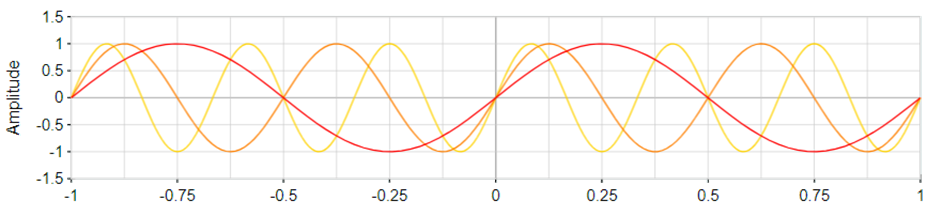
Figure 1. First three harmonics of a sine wave.
Note the crests and the troughs of those waves, and at which points they intersect. When waves combine through interference, we get new complex patterns (Figure 2).[10], [11]
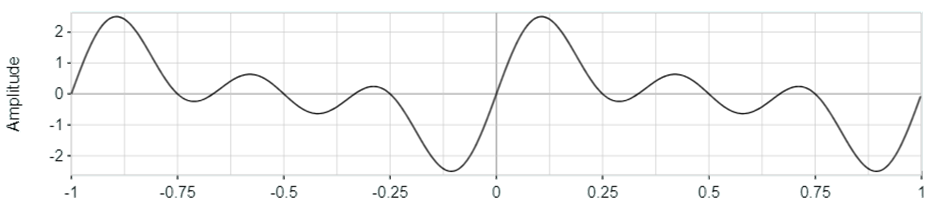
Figure 2. Constructive interference of first three wave harmonics.
It is with this understanding that harmonics can be defined. Until this point, a formal definition was avoided in preference to a ‘we know harmony when we hear it’ approach. Harmony is the series of waves one obtains by multiplying a frequency by an integer n.
The basis for these tones is not purely audible beauty, but also mathematical beauty.
Not only do composers utilize this harmonic series to write music, but most musical instruments naturally produce quieter overtones of these harmonics naturally. Figure 3 shows a Fourier Transform of C3 on my piano. Notice all the harmonic overtones that are produced.[12]
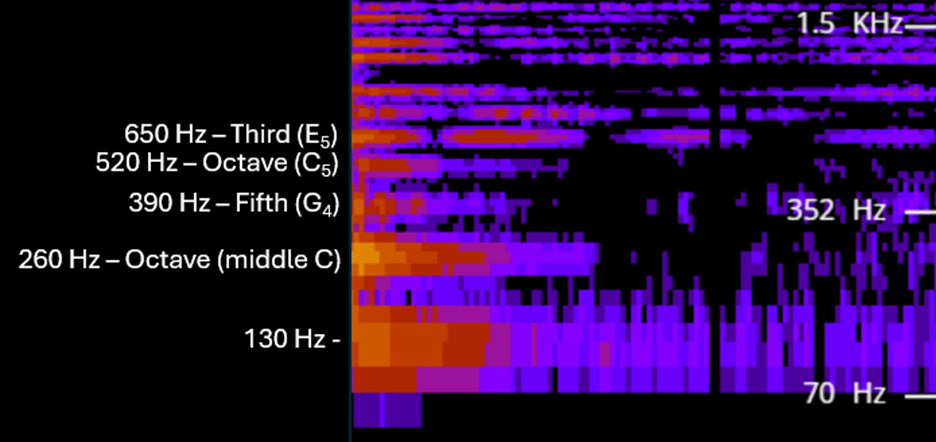
Figure 3. Overtones of a piano (1/7 comma meantone) visualized by a Fourier transform operation on a recording of C3. The vertical axis is frequency in Hz. Notice how closely the observed frequencies follow the harmonic series.
The relative loudness of each overtone is what makes each instrument sound unique.[13]
Harmonics: from Atoms to Astronomy
The ideas of harmonics need not stop at sound. Harmony is the language of the entire universe. Everything from the smallest particles to solar systems is governed by harmony and harmonic motion. Starting from the bottom, we consider the electron. Experiments in the early 1900s all but conclusively demonstrated that electrons behave as waves and particles.[14] Just as in musical waves, electrons may combine through constructive interference to form chemical bonds.[15] They can also cancel each other out in a process known as antibonding, which can break chemical bonds. Reactivity of a molecule is dictated by the energy and distribution of such electronic waves in spaces known as orbitals. When a high-energy pair of electrons moves into a large, low-energy empty orbital, a new chemical bond is formed.[16] Obviously, this process has numerous levels of complexity well outside the scope of this essay, but suffice it to say that the same principles of harmonics that make Bach’s music beautiful also make up the very essence of chemistry and consequently life.
Even after the molecules are formed, the electrons are still oscillating as waves inside of the chemical bonds. Depending on the amount of energy a particular molecule has at any time, numerous vibrational modes may be observed. These modes correspond to the harmonic series—the same harmonic series involved in sound.[17] In a way, every molecule is playing its own characteristic song with frequencies far above the range of hearing. Such songs can be investigated with molecular spectroscopy.
What is perhaps more surprising than the inherent harmonies in atoms are the inherent harmonies in planetary bodies. The basic idea that each planet or heavenly body is harmonic once again predates physics and goes back to the ancient thinkers: Pythagoras, Plato, Aristotle, Ptolemy, and Bede all reasoned that heavenly bodies simply must make noise when they move. Boethius called this sound the musica mundana. We sometimes make reference to it as the ‘music of the spheres.’ Among the various models of the universe was an evolving model by which each planet revolves around earth carried by its own aethereal sphere. The stars, because of their fixed relative positions, occupy the farthest visible sphere while the angels live beyond that primum mobile. The ancient philosophers rationalized that the motion of each of the spheres is moved out of love for God. If the planets sing when they move, and they move out of love for God, then they gloriously sing God’s praises! The heavens declare the glory of God; and the firmament sheweth his handywork.[18]
While the music of the spheres seems like an archaic, disproven concept, it turns out that these ancient thinkers were on to something. In the 17th century the now-famous astronomer Johannes Kepler demonstrated that the motion of all six known planets could be described using musical intervals and the concepts of harmony. Although these harmonies cannot be heard, Kepler rationalized that they could be felt and provide a basis for the connection between music theory, geometry, arithmetic and astronomy—the quadrivium. Kepler was a Lutheran, and recognized God’s fingerprints in creation.[19]
Back to Bach
Having examined the physics of music and harmony, we can now return to how Bach and his music relate to our Creator. I am not going to contrive that Bach had a secret knack for physics back in 1700. The truth is much simpler: harmony is the language of the universe. Every atom bears testimony to this simple fact, and every human being is attracted to the audible harmonies that resonate with the Glory of God. Bach was a master at his craft; he knew how to listen, how to conceptualize, how to capture, and how to recreate these harmonies better than all but one other. In other words, Bach was the best interpreter between the language of the universe and the universal language of music. How special it is for us that God, in His grace, as the same Creator who composed this cosmic symphony, endowed Bach with such an extraordinary talent.
I write this not only as a scientist, but also as a Lutheran. I am humbled that Bach and I share the same faith. How blessed it is that we still play and sing many of Bach’s most beloved compositions during worship. Bach’s preferred choices of medium are the organ and human voice—two instruments that glorify God beautifully. While many composers penned elaborate masses only for them to fall out of use shortly thereafter, Bach’s music withstood the test of time. This is no accident; we do not (or rather, we should not) continue playing and singing Bach chorales simply because he is Lutheran. We sing Bach because his music is a call into communion with Jesus. At the bottom of every one of Bach’s compositions is the abbreviation SDG: soli Deo gloria, with which he dedicates his composition to the glory of God. Jesus says in the Gospel of John “the sheep hear my voice.” Bach, sometimes regarded as “the fifth evangelist” gives us music that is so rich in the harmonies God set forth in the universe that it invites us up to be with Him and sing in harmony with the saints in heaven. Just as harmonies, by definition, cannot exist as independent tones, we Christians are designed to be with one another and with Christ.
Perhaps the best song we lift up to God is the Sanctus when sung at the Divine Service. Here we are wholly (no pun intended) united with the Church catholic as we celebrate the union of Christ and His church. We are united in song (Rev. 4:8), in music (harmony; see text), in the Word and the forgiveness of sins. We declare that Heaven and Earth are full of God’s Glory—the Lord’s Supper unites us and the saints before us through Christ who comes in the Name of the Lord. Alleluia! If you have never heard the Sanctus from Bach’s Mass in B minor (BWV 232), I encourage you to listen now.
Bach’s music, though unable to provide solid scientific proof[20] for the Divine λόγος, still draws us to the Creator and beckons us to sing with the saints in Heaven. It achieves this not through some subjective form of beauty, but by directly connecting us with one of God’s clearly perceived invisible attributes,[21] viz., harmony. Bach’s last sentence on earth before meeting Jesus Christ face to face was “Don’t weep for me; I’m going where music was invented!” Let us Christians cling to God’s Word, to the forgiveness of sins, and to the Lord’s Supper until we are called to never-ending songs of praise with Bach and all the other saints in Heaven.
Don’t weep for me; I’m going where music was invented!
Johann Sebastian Bach
Soli Deo Gloria
Further reading:
Maor, E. Music by the Numbers; Princeton University Press, 2018.
James, J. The Music of the Spheres; Copernicus Books, 1995.
Gilbert, P.U.P.A. Physics in the Arts; Academic Press, 2021.
Gardiner, J.E. Bach: Music in the Castle of Heaven; Knopf, 2013.
[1] Kreeft, P. and Tacelli, R.K. Handbook of Christian Apologetics. InterVarsity Press Academic, 1994. p 81
[2] Bach’s Brandenburg Concerto no. 2, Partita for Violin, and Prelude and Fugue in C Major from the Well-Tempered Klavier were included amongst a number of recordings aboard the Voyager that celebrate human achievement. Bach was the only musician to have three unique compositions on these discs. Voyager 1 & 2 were launched in 1977 and are both currently 0.002 light years away (in interstellar space) travelling at ~35,000 miles per hour, as of 2024. Data from the National Aeronautics and Space Administration.
[3] This is not to completely undermine personal tastes. There is certainly a more subjective element to music (just as there is a subjective quality to all art and things some call ‘art’), but any reasonable human from a young age instinctively recognizes that some combinations of notes invoke different feelings than others. The simplest way to recognize this is to compare a major chord—say C major (C, E, and G) to something like B diminished (B, D, and F; the top and bottom notes make up a tritone interval). Consider also the dissonance of an orchestra while warming up. At the beginning of the performance, the oboist plays a single pitch to which the entire orchestra harmonizes, bringing order out of the dissonant chaos.
[4] For example, a common technique for rectifying a diminished chord is to ‘open’ the tritone so it resolves on a major (in the case of B diminished; resolve to F# major). This is not the only technique. My favorite example is in the arrangement of “O Come, All Ye Faithful” by Sir David Willcocks. Listen to the complex harmony progressions in the last verse.
[5] Pipe organs, the most powerful and most versatile musical instruments on the planet, take advantage of these harmonic principles. The relative pipe length is printed on the stop. A 16’ pipe is an octave lower than an 8’ pipe. Pulling both stops will sound two pipes one octave apart for each key pressed. Special stops called ‘mutations’ (often labelled with names like ‘nazat’ or ‘terz’) sound pipes that are simple fractions of the corresponding 8’ tone to form intervals of fifths and thirds. This is how organs can produce such massive sounds!
[6] God uses 12 throughout the scriptures to convey completeness and Divine authority.
[7] From C, one could go up a fifth to G. Another fifth would bring one to D’, which can be lowered an octave to D. A fifth from D is A, then E, and the octave below is E. We can keep going all through B, F#, Db, Ab, Eb, Bb, F, then arrive almost back at C’ for a 12-tone octave. That is why music has 12 tones.
[8] Doolittle, E.L.; Gingras, B.; Endres, D.M.; Fitch, W.T. Overtone-based pitch selection in hermit thrush song: Unexpected convergence with scale construction in human music. PNAS. 2014, 111(46), 16616-16621
[9] As a quick aside: one can never ‘perfectly’ walk around the circle of fifths to a note that is exactly the same as the octave. That is because octaves will always scale by (2)n (even numbered frequencies) and fifths scale by (3/2)n (octave fractions of odd numbered frequencies).Even numbers cannot be odd, so the series do not converge; you can never perfectly close the circle of fifths. Numerous musicians have dealt with this problem in myriad ways, but I see it not as a fault, for this small difference (called a ‘comma’) can be harnessed to give music emotion and character. The current way of dealing with it is to eliminate the comma altogether by a process called ’12-tone equal temperament,’ which removes emotion from music by making every key exactly the same from the one before it. If the comma was designed purposefully by the creator, equal temperament is sinful man’s rejection of His design!.
[10] Combinations can be deconstructed through a process known as Fourier Transform—which is applied in spectroscopy, recording, MRI, and computational studies.
[11] Wave simulations were generated using PHET software from the University of Colorado. If you think this is interesting, consider visiting https://phet.colorado.edu/en/simulations/fourier-making-waves to make your own waves.
[12] You can compare the overtones of instruments you play by recording a note and using https://academo.org/demos/spectrum-analyzer/ for a Fourier transform analysis.
[13] The pipe organ is yet another good demonstration of this. Soft flutes like ‘bourdon’ or ‘rohrflöte’ have very quiet overtones, so the note is very one-dimensional, quiet, and gentle tone. Diapasons like ‘principle’ or ‘octave’ have louder overtones, and ‘string’ pipes like ‘gamba’ or ‘viola’ have very loud overtones to mimic string instruments. The difference between these pipes is the scale: how wide the pipe is relative to its length. Wider pipes produce fewer overtones. The PHET simulation in footnote 11 is a good pedagogical tool for students of the organ; one may adjust the overtones to recreate different organ ranks and see which harmonics are most responsible for the sound. (Special note on the topic of organs: many organs have a special stop called “celeste.” This stop is tuned slightly sharper than the others, so the waves will destructively interfere with other pipes and cause a vibrato effect!)
[14] In fact, all objects exhibit wave-particle duality; the things with which we typically interact are often much too big and much too slow-moving that the corresponding wavelengths can be ignored.
[15] The Heisenberg uncertainty principle says that we can never know the simultaneous position and momentum of an electron; the best one can do is find the probability density by squaring the ‘wavefunction’—a mathematical treatment of the electron. Electrons may be treated as waves surrounding atoms.
[16] This is also to say nothing of the interaction of light, yet another wave, and atoms. The photoelectric effect was a foundational concept in quantum science that revolutionized physics in the early 1900s. Today light is utilized in many synthetic chemical reactions to excite electrons in molecules into triplet energy states to gain better control of challenging reaction outcomes.
[17] The second harmonic of a molecular vibration is exactly twice the frequency—akin to an octave. The third harmonic is 3/2: the musical fifth. The fourth harmonic is another octave. The next harmonic is 5/4: the musical third.
[18] Psalm 19:1 KJV
[19] Music is not only seen in planetary motion, but also planetary electromagnetic fields. A 20th-century physicist Winfried Schumann studied the electromagnetic waves that propagate in the earth’s ionosphere. The fundamental frequency is about 7.8 Hz, an inaudible B, depending on the activity in the ionosphere at the time of measurement.
[20] ‘Scientific proof’ is a bit of an oxymoron, anyway. Science seeks to find the best natural explanation for a set of observations. It works inductively, and therefore is subject to change. Furthermore, God transcends the natural world. There will never be ‘scientific proof’ for God.
[21] Rom. 1:20
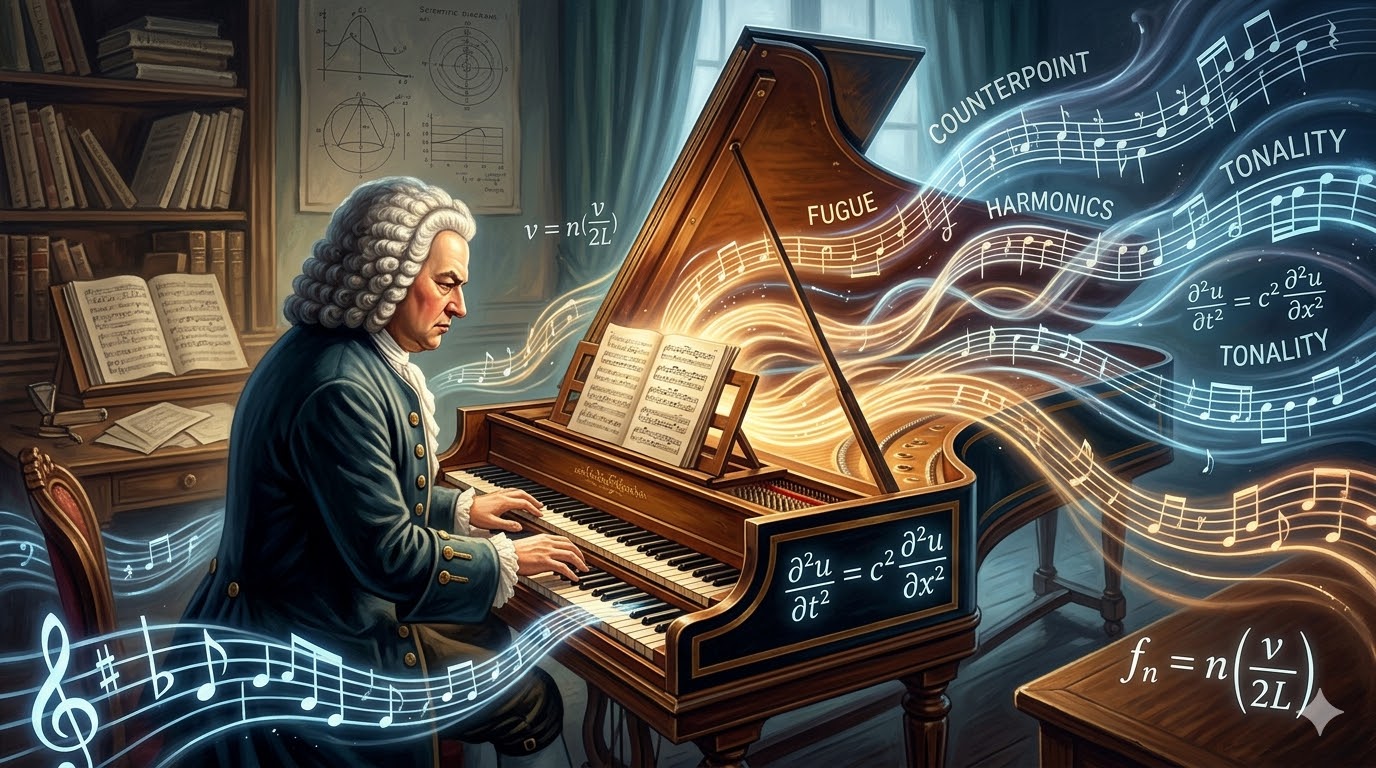
Featured Image: Bach Composing his Cosmic Symphony; Made with Gemini AI


Leave a Comment