
Why strive for something when God will give it to you for free?
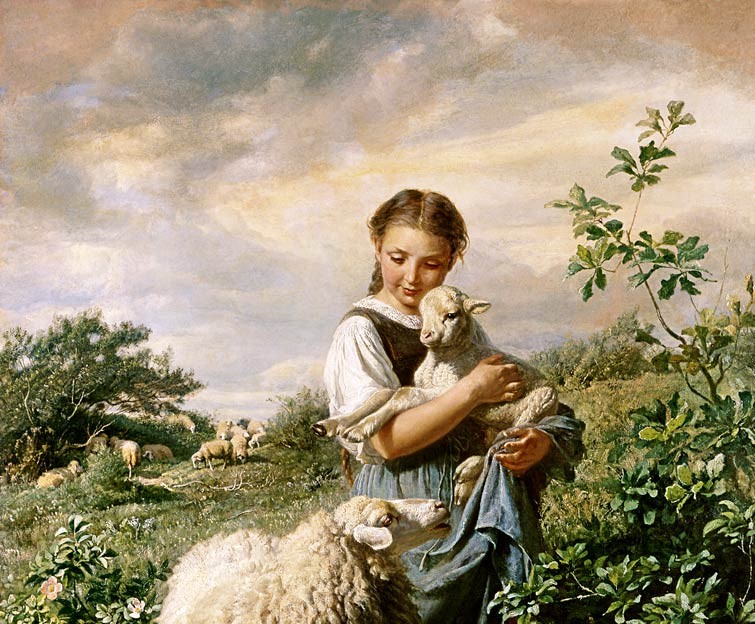
In my living room, my wife and I have a large facsimile of Johann Baptist Hofner’s famous painting The Little Shepherdess. We saw this masterpiece at a thrift store and could not resist; it matches our aesthetic perfectly! I am not such a strong appreciator of the visual arts (this is not to say that I do not value painting and sculpture; I just have a more difficult time finding meaning in a painting than others do. I much prefer music, but that is an aside…), but there is something that even I find alluring in this painting. The print that occupies the frame is a cheap reproduction. Hofner’s original masterpiece has much warmer tones, more detail, was larger in size, and had a slightly different aspect ratio than what we have.
Anything worth having has inspired cheap reproductions or knock-offs. Counterfeit $20- bills. Art reproductions. Forged signatures on sports memorabilia. Fake designer clothes or accessories. Cubic zirconia passed off as diamonds. My friend, Eden, even told me about a Chinese car manufacturer that makes Porsche knockoffs fraught with problems you would not find on the authentic models. Consider how much striving goes into designing, manufacturing, selling, and acquiring cheap look-alikes!
Authenticity is valuable. Counterfeit $20-bills are not worth the paper on which they are printed. I read somewhere about a man who scrapped his ‘Porsche’ knockoff the same day he purchased it. Although I don’t take issue with my facsimile of The Little Shepherdess, suppose one day an art collector should show up at my door and offer me the original 1866 painting, for free, to hang up in my home. I would be a fool not to take it! Surprisingly, we all exhibit this same foolishness when it comes to the good gifts that God freely offers us.
To Know Wisdom and Discipline
In the second verse of the Book of Proverbs, King Solomon establishes the triad that serves as the foundation of a godly life: knowledge, wisdom, and discipline. His whole purpose in writing Proverbs is so that we may “know wisdom and discipline; to perceive the words of understanding.” Last year, Rev. Jonathan Fisk made this a theme verse at my congregation and wrote about the three gifts of knowledge, wisdom, and discipline at length. You can read some of his thoughts on his Blog. The beauty of knowledge, wisdom, and discipline is that God is generous with these gifts and freely gives them to us. Having these gifts represents one’s joyful reception of God’s divine order.
Every good and perfect gift is from above, coming down from the Father of lights, who does not change like shifting shadows.
James 1:17 CSB
Now if any of you lacks wisdom, he should ask God—who gives to all generously and ungrudgingly—and it will be given to him.
James 1:5 CSB
Anything worth having has inspired cheap reproductions or knock-offs. In our sinfulness, we routinely reject the gifts offered to us by God in favor of what we can conjure up ourselves. The Bible calls it foolishness; we call it autonomy. We do not want the wisdom that God offers. We want to go our own way and earn it for ourselves. We want the ego, the pride. We want it our way.
For the word of the cross is foolishness to those who are perishing, but it is the power of God to us who are being saved. For it is written, I will destroy the wisdom of the wise, and I will set aside the intelligence of the intelligent.
1 Corinthians 1:18-19 CSB
When human striving attempts to seize the virtues of knowledge, wisdom, and discipline without submission to God, we find ourselves with simulacra—an insubstantial form or semblance of something. We seek knowledge; we find Gnosticism. We seek wisdom, we find sophistry. We seek discipline, we find asceticism. Just as bank tellers are able to spot counterfeit money, it is just as easy to spot these fake virtues from the real ones.
Knowledge versus Gnosticism
Knowledge is a beautiful gift from God, and begins with the fear of the Lord (Proverbs 1:7). It is something that is given to you, a holder of knowledge. The Hebrew word for knowledge, da’at, derives from the verb yada meaning ‘to know’ (this is also where yada yada yada comes from), which is similar to the word for hand, yad. Knowledge is in your hand—but only if it is put there. Thomas Aquinas explains this idea better than I ever could in his Summa Theologica:
The interior light of the intellect is the principal cause of knowledge. But both of these are from God. Therefore as of God is it written: ‘Who healeth all thy diseases’ (Ps. 102:3); so of Him is it written: ‘He that teacheth man knowledge’ (Ps. 93:10).
Because knowledge is a gift from God, it ought to lead us towards stewardship and praise. Of course, the best knowledge one can possess is the truth that Jesus Christ paid the price for your sins and is risen. This knowledge is both necessary and sufficient for salvation, and the chief source of this knowledge is the Holy Ghost.
Gnosticism is the first simulacrum I will address in this post. From the outside, Gnosticism can look very similar to knowledge, especially in our post-Enlightenment world that treats science as the sole source of knowledge (a flawed, self-refuting belief known as scientism). The origins of Gnosticism are ancient, dating back to 2nd-century ideas that Christ is not enough, and salvation comes through your own special knowledge. This idea did not disappear over the last 1900 years, but rather it evolved. When people deny objective Truth and instead say that everyone has his or her own truth, that is Gnosticism. When people behave as if they possess knowledge that others do not, that is Gnosticism. When people say that Jesus was an enlightened teacher like Buddha, and not the Christ, that is Gnosticism. Finally, when people believe that they can achieve eternal life without God’s love, grace, and forgiveness, that is Gnosticism. For a better understanding of Gnosticism, consider checking out any book authored by Joel Osteen from your public library.
While the Christian reverently apprehends God’s created order, the Gnostic engineers his or her own reality while grasping for intellectual powers. The soul of the knowledgeable Christian is receptive and humble, while the Gnostic is proud and esoteric. Knowledge yields praise and stewardship. Gnosticism creates self-deification and confidence artists.
Wisdom versus Sophistry
In Aristophanes’ Clouds, Strepsiades sends his son, Pheidippides, to Socrates’ Thinkery to become educated in the art of Sophistry, believing that the skill of turning poor thinking into winning arguments is what Strepsiades needs to get out of debt. Pheidippides leaves the Thinkery and uses his new Sophistry skills to justify beating up his father.
Like knowledge, the beginning of wisdom is the Fear of the Lord. Wisdom cannot exist independently of God’s providence, and will therefore always yield to Christ. Wisdom not only encourages one to align himself or herself to Christ, but it also steers one away from sin and folly. It is the application of Truth in love. In Proverbs, wisdom is personified as a woman. In the New Testament, it is personified as Christ:
Yet to those who are called, both Jews and Greeks, Christ is the power of God and the wisdom of God, because God’s foolishness is wiser than human wisdom, and God’s weakness is stronger than human strength.
1 Corinthians 1:24-25 CSB
In [Jesus] are hidden all the treasures of wisdom and knowledge.
Colossians 2:3
Sophistry is striving for wisdom. Sophia is wisdom. The suffix –istry comes from Latin and denotes a practice or art, therefore indicating some sort of attempt. If one is attempting wisdom, that is, by definition, not wisdom. Like the students of Socrates’ Thinkery, sophistry is persuasion. It is the art of winning the argument but losing your soul. Aristophanes wrote Clouds as a sort of satire against the misuse of reason. Socrates was in fact very much aware of the dangers of Sophistry. In Plato’s Republic, Socrates warns that the sophist “is a manufacturer of images and is far from the truth.”
While true wisdom seeks to yield and align with Christ and His will, Sophistry is focused on using words to attain persuasion, power, and vanity. Sophistry is the mere appearance of truth, while wisdom is the application of Truth (capital-T) in love.
Discipline versus Asceticism
Discipline is discipleship. It is the daily framework allowing us to fulfil our vocations. Christian freedom (the freedom to serve one’s neighbor, not the freedom to do what one wants), liberated by the Gospel, flows through discipline. David describes true discipline in Psalm 119:32; a joyous, eager obedience springing forth from the soul that is secure in God’s love.
I pursue the way of your commands, for you broaden my understanding.
Psalm 119:32 CSB
Asceticism is works-righteousness disguised as discipline. Fasting, cold showers, severe, imposed rules meant to punish the flesh all combined with the idea that God owes you for climbing the ladder of moral obedience. Asceticism is transactional: “I suffer, therefore God owes me!.”
Although these have a reputation for wisdom by promoting self-made religion, false humility, and severe treatment of the body, they are not of any value in curbing self-indulgence.
Colossians 2:23 CSB
Martin Luther was an excellent teacher of the dangers of asceticism, having very nearly killed himself with ascetic practices before realizing that we are saved by grace. He writes in his commentary to Galatians:
I gained out of the books of the scholastics and church fathers… [the idea of] an awesome saint in the desert, who avoided the society of men, subsisting on a diet of roots and herbs. But we know now from the Scriptures who the true saints are. Not those who live a single life, or make a fetish of days, meats, clothes, and such things. The true saints are those who believe that they are justified by the death of Christ… Their holiness is a gift and not their own personal achievement.
While discipline is the joyful response of freedom in Christ, asceticism is an effort towards works-based righteousness seeking to pacify a tyrannical God through bondage. Discipline allows one freedom to love his or her neighbor, but asceticism only succeeds in spiritual pride.
Simulacra, Hermeneutics, and Homiletics
Even though knowledge, wisdom, and discipline are so easily attained from God, people continue to strive, always ending up at Gnosticism, sophistry, and asceticism. It is my observation that certain Christian traditions, even when well-meaning, unintentionally arrive at a simulacrum based on what is valued in each hermeneutic tradition. There is no better place to look to understand this concept than a sermon.
Many Big-Eva Megachurches preach Gnosticism in disguise. Rather than Christ crucified, the forgiveness of sins, and the promise of eternal life, megachurch pastors such as Joel Osteen, T.D. Jakes, Rick Warren, and Joyce Meyer routinely preach the “Gospel of Self-Help.” Their positive, uplifting, and inspirational messages, often denying the reality of sin and hell while affirming introspection and prosperity, have overt Gnostic tendencies such as turning inward for truth, hidden or elite knowledge, redefining Jesus, and detaching the Church from the means of grace. Even other pastors like Craig Groeschel, while not obviously Gnostic, can exhibit some tendencies towards life strategy. Excellent, Biblical preaching is always focused on Christ and what He accomplished for us, not what we can accomplish for ourselves.
Asceticism is rampant in Eastern Orthodoxy and Catholicism. Both of these church bodies assume a semi-Pelagian attitude (that they will deny if accused) that one must cooperate with God’s grace. While Protestants with a proper understanding of discipline do good works in a joyful response to being saved, Catholics believe that works are a necessary part of cooperating with God’s grace. How dismal! If cooperation falls on us, and denial and restraint are virtuous actions (Luke 9:23), it logically follows that radical denial of self can lead one to a higher path of holiness. Asceticism is about mistaking yourself to be holy before a God who really is holy. That is a truly scary concept. We are not deserving of God’s grace. We are declared righteous for Christ’s sake.
For all have sinned and fall short of the glory of God; they are justified freely by his grace through the redemption that is in Christ Jesus.
Romans 3:23-24 CSB
For you are saved by grace through faith, and this is not from yourselves; it is God’s gift— not from works, so that no one can boast.
Ephesians 2:8-9
Let us now address sophistry. This one hits close to home. I see a lot of Lutherans striving towards sophistry. Of course, this is obvious in the preaching. ‘Average’ Lutheran preaching is often the same homiletic Mad-Lib: “[Insert Law], [Insert Gospel], Go in peace.” Pastors are trained in seminary to dress up their sermons with fancy language to impress and woo the parishioners. Young men out of seminary desire the appearance of wisdom, and they often succeed in it. The problem that I find is that most Lutheran sermons following this recipe are strikingly similar. The big theological words are different, but the concepts are the same week after week. While some might prefer this style, and while I acknowledge it has a time and a place, it frequently is accompanied by a serious fault: the Bible is rarely opened. I’ve been to churches where the only time the pastor quoted the Bible in his sermon was by mistake after thinking it was a quote from one of Luther’s Commentaries. The scholastic tradition of the Lutheran church is so rich that some men in the pulpit would rather open up a book about a book about the Bible rather than the Font- the Bible itself. In these churches, the Bible is only opened at a less-attended Bible Study in the undercroft, when the pastor finally does what he should do in the pulpit: exposition and exegesis! Sadly, the pastors that succeed in preaching excellent sermons are often criticized by their peers: “That’s not a sermon, that’s a Bible study!” Please do not seek to shame or humiliate faithful shepherds who deliver strong exegetical sermons!
Why Strive for Fake?
If God freely gives genuine knowledge, wisdom, and discipline… then why do we go out of our way for the fakes? Why is history a relentless march towards Gnosticism, sophistry, and asceticism?
In the Garden, Eve was deceived and Adam disobeyed. There is a lot of irony there; Adam and Eve were more like God than any of us could ever imagine ourselves. Yet when Eve was promised that the forbidden fruit would make her more like God, she and Adam ate it and became less like Him. This was the first act of Gnosticism ever committed. This was an act of self-deification. Adam and Eve trusted their own instincts, their own truth, and their own desires rather than the Truth from God.
As sinners, we humans are fascinated with autonomy and desire it deeply. We want to be in control of our own lives, minds, and destinies. We despise being on a receiving end of a gift, because accepting a gift requires humility. We must come with empty hands and acknowledge that we are nobody and nothing without God. If we can strive for our own intellect, argue our way to the top, or purify ourselves, then the glory is ours. That is what our sinful nature desires. As Milton captured in Paradise Lost, we tell ourselves it is “better to reign in Hell, than serve in Heaven.” We wish to forsake the kingdom of God in favor of our own crumbling Towers of Babel.
The Posture of Proper Reception
In Heretics, G.K. Chesterton observed that humility is the gateway to virtue:
Humility is so practical a virtue that men think it must be a vice. Humility is so successful that it is mistaken for pride… The man who expects nothing sees redder roses than common men can see, and greener grass, and a more startling sun. Blessed is he that expecteth nothing, for he shall possess the cities and the mountains.
To receive God’s good gifts, know your place. Come to God with empty hands. Acknowledge that He alone is the Font. Humbly ask him. He will give it to you.


Leave a Comment